Hui Tuo Power
Protection of Voltage Transformers by Primary Harmonic Eliminators
Protection of Voltage Transformers by Primary Harmonic Eliminators
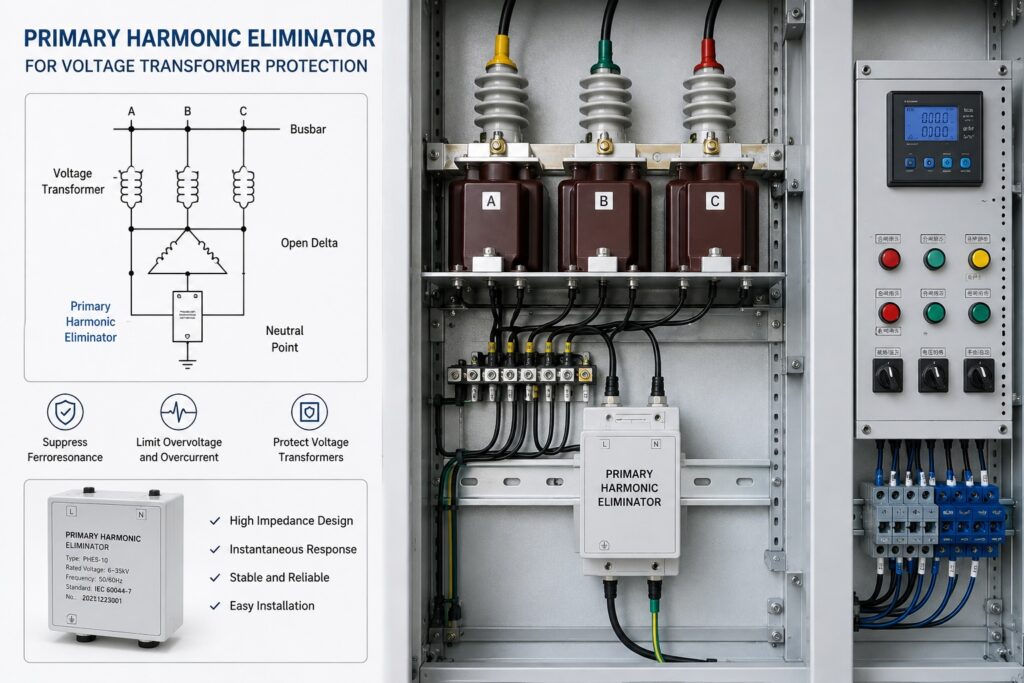
Primary harmonic eliminators are commonly used to protect voltage transformers from the influence of ferroresonance. In power distribution systems, ferroresonance may cause abnormal overcurrent or overvoltage, which can seriously damage voltage transformers and affect the safe operation of electrical equipment.
When low-frequency resonance occurs, the excitation impedance of the voltage transformer may decrease significantly. This can lead to deep saturation of the iron core and a rapid increase in excitation current. In severe cases, the excitation current may reach dozens or even hundreds of times the rated value, causing serious damage to the voltage transformer.
Common Damage Caused by Ferroresonance
Ferroresonance may damage voltage transformers in different ways. Two common situations are as follows:
1. Burning of the Primary Winding
The primary winding of a voltage transformer may be burned due to continuous ferroresonance. This situation may occur when a no-load bus is energized. If the capacitance to ground of the bus is relatively small, high-frequency resonance overvoltage may be generated, which can damage the voltage transformer winding.
2. Frequent Blowing of High Voltage Fuses
Frequent blowing of high voltage fuses may be caused by ultra-low-frequency ferroresonance. This type of resonance can occur at the moment when a single-phase grounding fault disappears. At this moment, a short electromagnetic oscillation may be formed between the grid capacitance to ground and the excitation inductance of the voltage transformer.
This situation is more likely to occur in power grids with relatively large bus capacitance to ground, especially during intermittent arc grounding faults. In such cases, the influence of ferroresonance may become more serious.
Measures to Limit or Eliminate Ferroresonance
There are several methods to limit or eliminate ferroresonance in voltage transformer systems. These methods may be applied on the secondary side or the primary side of the voltage transformer to reduce resonance overvoltage and protect the equipment.
Adding a Harmonic Elimination Device to the Open Delta Winding
In some traditional systems, a simple resistance device or incandescent lamp was connected to the open end of the voltage transformer’s open delta winding. For example, a 220V, 500W incandescent lamp was once used as a simple harmonic elimination method.
At the initial stage of resonance, the lamp has a relatively small resistance, which helps suppress resonance. When a single-phase steady grounding condition occurs, the resistance increases, helping to avoid overload of the voltage transformer. This method is simple and economical, but it also has certain limitations.
Limitations of Traditional Resistance-Based Methods
The smaller the resistance value of the harmonic elimination device, the stronger its ability to suppress resonance. However, if the resistance is too small, the corresponding power becomes too large. This makes it difficult to select suitable resistance materials, and the capacity of the voltage transformer may also become insufficient.
In addition, if the voltage at both ends of the open delta winding becomes too low, the correct operation of relay protection may be affected. Therefore, traditional resistance-based harmonic elimination methods have some disadvantages:
- When a non-metallic grounding fault occurs, the neutral point displacement voltage may be small, and the circuit may not provide sufficient damping, making resonance difficult to eliminate.
- When a metallic single-phase grounding fault occurs, the open delta winding of the voltage transformer must have sufficient capacity to avoid winding damage.
- When an intermittent arc grounding fault occurs, the connected resistance may significantly increase the current flowing through the primary winding of the voltage transformer, increasing the possibility of damage.
Microcomputer-Based Harmonic Elimination Devices
A microcomputer-based harmonic elimination device can also be installed at the open end of the open delta winding of the voltage transformer. This type of electronic harmonic eliminator can instantly connect a high-impedance circuit when resonance occurs, providing a good harmonic elimination effect.
However, this method may not be effective for low-frequency oscillation. Therefore, it is more suitable for power grids with relatively small capacitance to ground.
Primary-Side Neutral Point High-Impedance Grounding
Another method is to connect the neutral point on the primary side of the voltage transformer to ground through high impedance. In some systems, a single-phase zero-sequence voltage transformer is connected between the primary-side neutral point and ground of a three-phase voltage transformer or three single-phase voltage transformers. This method is often referred to as the “4TV method” and belongs to primary harmonic elimination.
Characteristics of Primary Harmonic Eliminators
Primary harmonic eliminators have several important characteristics:
- The compensation effect of the zero-sequence voltage transformer secondary winding can help eliminate the influence of third harmonics in secondary phase voltage measurement.
- The open delta circuit of the three-phase voltage transformer can be short-circuited or connected into a closed triangle to reduce third harmonics and help eliminate ferroresonance.
- In the zero-sequence circuit, there is only one single-phase voltage transformer as the inductive element. Compared with the excitation inductance of a three-phase voltage transformer, it is much smaller. Under overvoltage excitation, its inductive reactance is not likely to become equal to the grid capacitance to ground, so the necessary conditions for ferroresonance are difficult to form.
Because of these characteristics, primary harmonic eliminators can effectively suppress or eliminate ferroresonance. They also have a good effect on ultra-low-frequency resonance and are suitable for power grids with relatively large capacitance to ground.
Conclusion
Ferroresonance can cause serious damage to voltage transformers, including winding burnout, frequent fuse blowing, insulation stress, and abnormal overvoltage. Primary harmonic eliminators help reduce these risks by suppressing resonance conditions and improving the stability of voltage transformer operation. Proper selection and application of harmonic elimination devices are important for the safe and reliable operation of power distribution systems.